
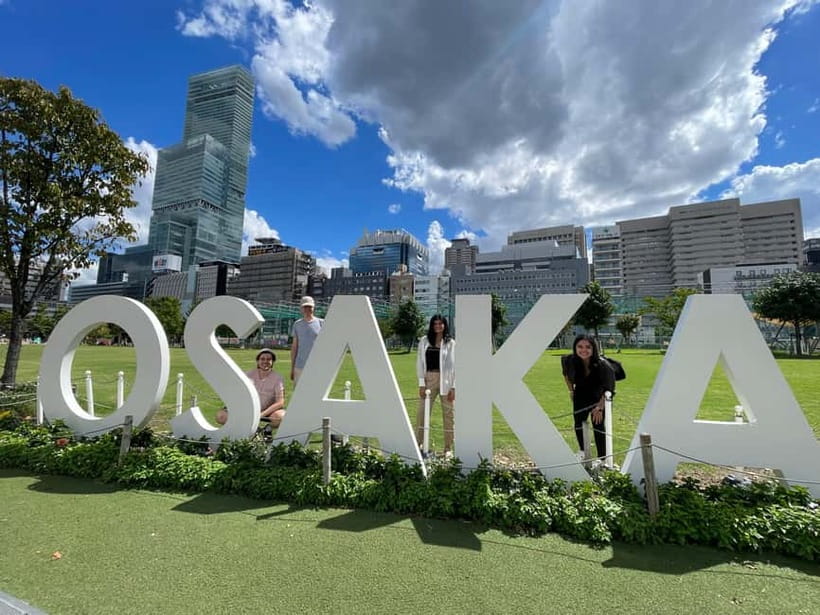
REVIEW · CYCLING TOURS
Osaka: Bike Adventure with Lunch
Osaka looks different from a bike. I love the way this ride strings together iconic stops like Osaka Castle and the Japan Mint, and I also love that lunch is a proper local meal, not a snack. The drawback: it is only for people who can ride confidently, since you will be pedaling a lot.
You will ride with a small group limited to 8 people, and your guide works in English. Guides like Matt, Joel, and Danyk are praised for the same things you want on a bike tour, clear local context and an easy, fun pace.
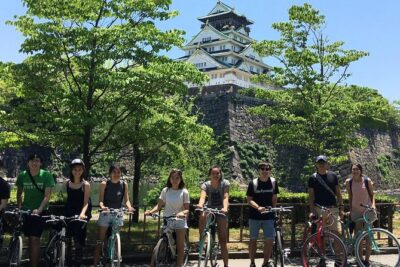
This route also leans into Osaka’s personality, with Nakanoshima Island gardens and the street energy of Shin-Sekai. Along the way you will stop at the Japan Mint, see Tsutenkaku Tower, visit Japan’s oldest temple, and finish with Osaka Castle.
Key points worth knowing before you go
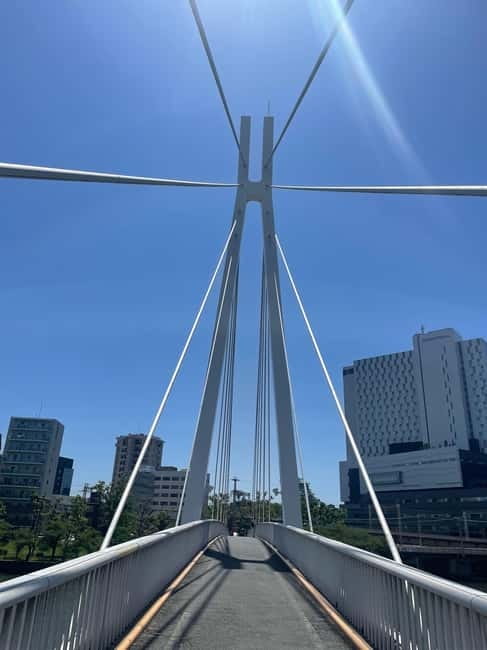
- Japan Mint start: You begin with a real landmark stop, not just a photo moment.
- Nakanoshima Island gardens by bike: European-style buildings and gardens change the mood fast.
- Lunch with a local eatery focus: You get a planned meal plus time to reset.
- Shin-Sekai and Tsutenkaku Tower: You get the famous neighborhood without getting lost in it.
- Small group, English guide: A tighter group means you can actually ask questions while moving.
- Osaka Castle as the finale: It gives your ride a satisfying big finish.
Getting Started Near Tenmabashi Station and Riding With a Small Group
The tour meets about 10 minutes’ walk from Tenmabashi station, so you should plan to arrive early and get your bearings. They ask you to show up 15 minutes before the start, which matters more than you might think. You’ll want time to get fitted with the bicycle and helmet, and to confirm any details with the guide.
This is not a huge bus-and-photos tour. It is a small group experience, capped at 8 participants, and that changes everything about the vibe. When the group is small, you can keep moving without feeling rushed. You can also hear your guide, even in busy areas, and you are more likely to get practical answers about food and what to try next.
The bike itself is part of the deal, along with the helmet. Since hotel pickup and drop-off are not included, you are responsible for getting yourself to the meeting point. That is normal for many bike tours, but it is still worth planning for so you do not start the day flustered.
One more reality check: this is not for kids under 13, and it is not for pregnant travelers. If you cannot ride a bike, you should not sign up. Even when the pace feels comfortable, the whole structure depends on steady cycling.
More of Osaka on two wheels
Japan Mint to Nakanoshima Island: Osaka’s Order Meets Its Charm
Your ride kicks off at the Japan Mint, and that is a great choice. It sets a tone of Osaka that is more than street food and neon. Starting with a landmark like the Mint means your guide can talk about Osaka’s place in Japan’s story, including the city’s contribution to feudal history.
From there you cruise toward Nakanoshima Island. What you are looking for here is the contrast. Instead of staying in pure urban traffic, you pass European-style buildings and gardens. That park-like, scenic shift is a big part of why this tour feels like an actual day out, not just a checklist.
By bike, you can glide through areas that would be slow or annoying on foot. You cover ground while still seeing details like the buildings, gardens, and street rhythm. The guide also shares context about local culture, including dialect and what makes Osaka’s food scene tick.
If you are the type of traveler who likes to connect the dots, this section is a win. You are not only seeing where to take a picture. You are learning why the city is shaped the way it is, and how that spills into daily life.
Lunch at a Local Osaka Eatery (Including a Curry Real-Life Option)
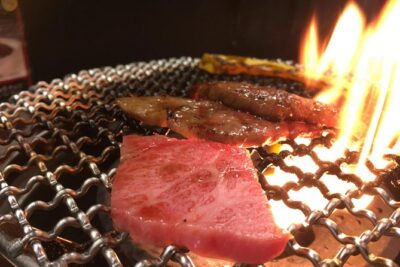
Lunch is built into the schedule at one of the guide’s favorite local eateries. That is one of the highest-value parts of the tour, because Osaka food is a big part of the city and it is easy to get stuck guessing when you are on your own.
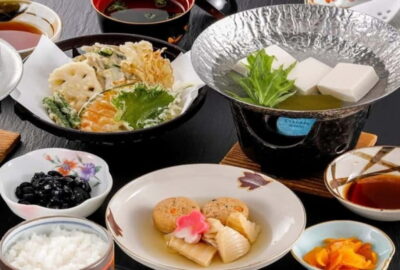
This is not a generic cafeteria stop. It is described as a quick lunch at a local eatery, and one guide praised Japanese curry as the lunch highlight. Even if your meal is different, the point is consistent: you are eating what locals eat, in the middle of the ride, with fewer decisions for you to make.
You also get water included, which matters because you will be riding for hours. Keeping hydration simple is one less thing you have to think about, especially if the day is warm.
A practical tip: if you have dietary restrictions, you need to provide that info in advance. The tour asks for dietary restrictions ahead of time, so communicate clearly before you go. That is the difference between a smooth meal and a last-minute scramble.
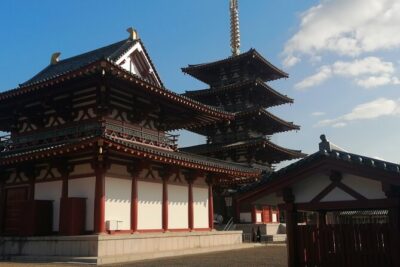
Japan’s Oldest Temple and Tsutenkaku Tower Before Shin-Sekai
After lunch, the tour shifts into classic Osaka landmarks. You will visit Japan’s oldest temple, then head to a major tall landmark experience before entering Shin-Sekai.
The tallest-building moment ties into the Tsutenkaku Tower stop. Even if you do not care about heights, Tsutenkaku is one of those places that anchors the neighborhood’s identity. It is where the neighborhood’s character snaps into focus.
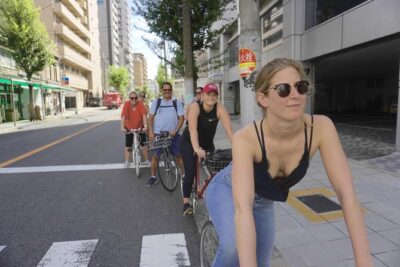
Then you transition into Shin-Sekai. This is the neighborhood you go to for atmosphere. Expect to pedal through the streets, not just stand at the edges. You get to see the area in motion, with your guide pointing out spots that are easy to miss on a casual walk.
Shin-Sekai can feel like Osaka’s funhouse version of history: older street patterns, strong local personality, and food culture right in your face. A bike helps because you can move with the flow and still take in what you see along the way.
One drawback to keep in mind: this part of the day depends on you being comfortable cycling in lively areas. It should still be manageable, but if you dislike crowded street riding, you might feel more stress here than in quieter garden sections.
Pedaling Through Shin-Sekai and Finishing at Osaka Castle
The second half of the day is where your guide earns their keep. You are not just traveling between attractions. You are learning how Osaka’s identity connects those places, from feudal-era context to modern street culture and food.
In Shin-Sekai, your guide will also help you understand cultural pieces like dialect, so the neighborhood feels less like random sights and more like a place with a voice. This kind of explanation is exactly what people tend to praise in bike tours, because it turns movement into meaning.
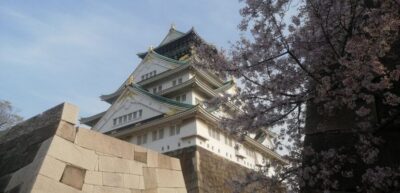
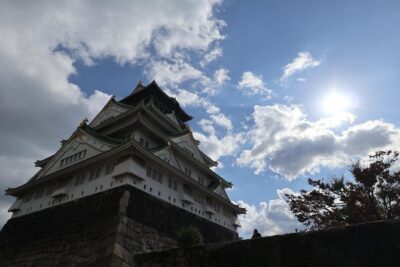
As the day closes, you finish with Osaka Castle. This makes the itinerary feel clean and satisfying. Castle stops are usually the hardest ones to build into a day because they can eat time, but ending there gives you a big visual payoff after you have already warmed up with smaller landmarks and neighborhoods.
If you like taking photos, this finish also helps. By the time you reach the Castle area, you have been riding long enough to get into the rhythm, and your eyes have the context to notice what you are seeing.
Since the tour duration is about 330 minutes, you are looking at a full morning-to-afternoon block of sightseeing. You should still keep your expectations realistic: you will see a lot, but you will not have endless time to linger at every stop.
Set this against a few other Osaka bookings:
Pace, Fitness, and What to Bring (and Skip)
This tour is for people who can ride a bike. That does not automatically mean you need to be an athlete, but you should be in decent shape and comfortable with repeated pedaling. One review highlighted that even a 70-year-old group member handled the ride well, which suggests the route is designed to be doable for typical travelers in good condition.
Still, consider your comfort level with bicycles and street riding. If you get nervous around traffic or you cannot balance confidently, this is the wrong activity.
What to bring is simple and practical:
- Comfortable shoes (you will also be walking some)
- Comfortable clothes suited for cycling
- A camera if you want photos
They also note no smoking, which is a standard expectation for guided tours.
The tour asks you to provide heights for everyone in your group. That is not trivia. It affects bicycle fitting. If you do not send the details, it can slow down the setup, and bike fitting is part of making the ride feel safe.
You should also share dietary restrictions ahead of time. Lunch is included, and the plan depends on them knowing what you can eat.
Finally, rain is handled with common-sense rules. If the chance of rain is higher than 60%, the operator contacts you to offer a different date or a full refund. Make sure you are reachable so you can react quickly.
Price and Value: What $103 Includes (and What It Does Not)
At $103 per person for about 330 minutes, this is priced like a true guided experience, not a cheap rental. The key value is that a lot is bundled:
- Bicycle rental
- Helmet
- Local guide in English
- Lunch
- Water
That means you are paying for an organized route, guidance, and food, plus the equipment that would otherwise require extra planning. If you tried to do the same day on your own, the biggest costs would be bike logistics, figuring out where to eat without wasting time, and paying someone to interpret the city’s history and culture as you ride.
What is not included is hotel pickup and drop-off. That can be fine, but it does shift the value equation slightly. If your hotel is far from Tenmabashi or getting there takes time, you need to budget that into your day. It does not make the tour bad. It just changes how you should plan your morning.
Group size also matters for value. With a maximum of 8 participants, you are more likely to get questions answered and to get a guide who can keep everyone together smoothly.
Should You Book This Osaka Bike Adventure With Lunch?
I think you should book this if you want Osaka in a single day without doing mental gymnastics. It has the right mix of landmark stops, neighborhood energy, and a real food break in the middle. The small group size and English guiding are a big part of why it works, and the praise for specific guides like Matt, Joel, and Danyk points to consistent, enthusiastic storytelling.
You should skip it if any of these are true: you cannot ride a bike confidently, you are pregnant, you are traveling with children under 13, or you really hate cycling in busier city areas. This is a bike adventure, not a walk-first tour with extra wheels.
If you are deciding between bike-and-food and another type of tour, use this quick test: if you want to learn Osaka’s culture and history while actually moving through it, this one is a strong fit. If you prefer to stay mostly stationary and do long museum-style stops, you may find the pace a bit too active.
FAQ
Where is the meeting point for the tour?
The meeting point is about 10 minutes’ walk from Tenmabashi station (Osaka metro or Keihan train).
How long is the tour?
The tour duration is 330 minutes.
What’s included in the price?
Bicycle rental, helmet, local guide, lunch, and water are included.
Is hotel pickup or drop-off included?
No. Hotel pickup and drop-off are not included.
Is this tour suitable for kids or teens?
The minimum age is 13 years. It is not suitable for children under 13.
Can pregnant travelers join?
No, it is not suitable for pregnant women.
What should I bring, and what is not allowed?
Bring comfortable shoes, a camera, and comfortable clothes. Smoking is not allowed.
What happens if it rains?
If the chance of rain is higher than 60%, they contact you to offer a different date or a full refund.
More Lunch Experiences in Osaka

Osaka on Two Wheels



More Tour Reviews in Osaka



Latest out of Osaka


Cycling Tours, side by side.
 ★ 5.05-Hour Osaka Bike Tour to the Neighborhood of Osaka CastleFrom $87319 reviews
 ★ 5.0One-Day Osaka Bike Adventure: 5–6 HoursFrom $106246 reviews
 ★ 5.0Eat, Drink & Cycle: Osaka Foodie Bike TourFrom $99224 reviews
 ★ 5.0Osaka E-Bike Tour with a Local GuideFrom $59219 reviews
 ★ 4.85-Hour Osaka Highlights Bike Tour with LunchFrom $85146 reviews
 ★ 5.0Osaka in a Nutshell: Three hour bike tourFrom $72121 reviews
★ 4.7Osaka E-Bike Tour With A Local GuideFrom $5775 reviews
 ★ 5.0Urban Canvas: Osaka Street Art Bike TourFrom $8947 reviews
Also worth a look in